
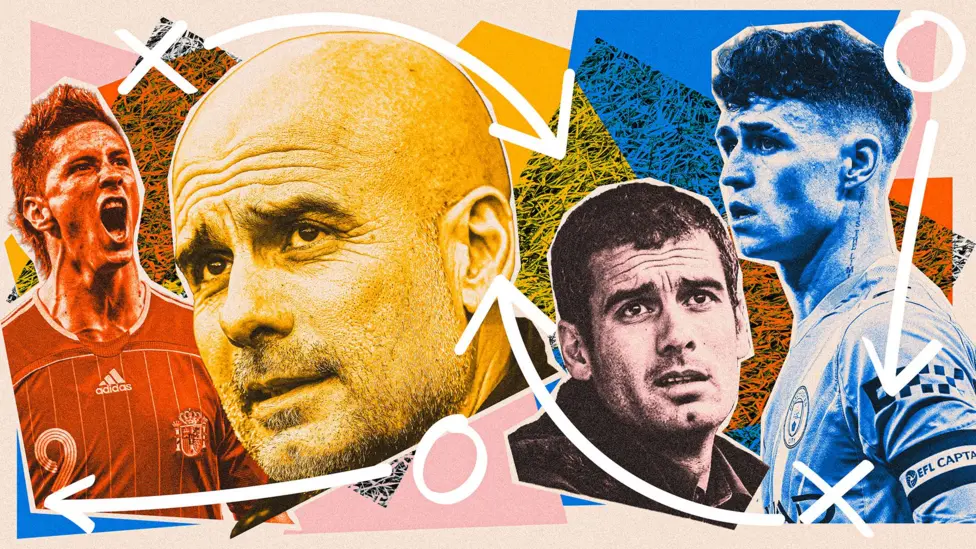
Last week, during a post-match press conference at the Etihad, I asked Pep Guardiola about the increasing density of his attacking midfield. His response was classic Pep: “Do you want to be my assistant coach? You are brilliant, you are top.”
While the room laughed, the question touched on a profound shift. In the legendary 2017-18 “Centurions” side, Leroy Sané and Raheem Sterling would finish games with white paint on their boots—stationed high and wide to stretch the pitch. Almost a decade later, in February 2026, Guardiola’s system is unrecognizable, favoring narrow, fluid attackers who thrive in a “central trap.”
From ‘White Paint’ to ‘Inside Channels’
The evolution from wide isolation to central overload isn’t just a trend; it’s a return to the principles Guardiola first outlined in his early El País columns (2007-2009). Back then, he wrote of his admiration for the 1995 Ajax and Rijkaard’s 3-4-3, where width was a “decoy” rather than a primary weapon.
The 2017 Model: Pure Width
- Wingers: Sané and Sterling stayed pinned to the touchlines.
- Goal: Create massive 1v1 isolation and low-cross “cutback” opportunities.
- Weakness: Vulnerability to central counter-attacks if possession was lost.
The 2026 Model: The 4-2-2-2 Box
In current matches against high-pressing sides like Tottenham and Arsenal, City now operates with a narrow 4-2-2-2 structure.
- Narrow Wingers: Players like Rayan Cherki and Jeremy Doku have abandoned the touchline, inverting into the half-spaces alongside Phil Foden.
- The Trap: By packing the center, City forces the opponent to narrow their defense. When the opposition “bites,” City releases the ball to inverted full-backs like Rico Lewis or Matheus Nunes who underlap into the box.
The El País Connection: ‘Money Buys Players, Not Ideas’
To understand why Pep has moved inside, we look back at his 2019 column titled “Dreamer, Fanatic, and Artist.” He argued that “the team speaks to its manager.” In 2026, with Erling Haaland serving as a gravity-well for defenders, Guardiola has realized that wide wingers are no longer the most efficient way to break down “low blocks.”
Instead, he has returned to the “Third Man” principle:
- Pass 1: Attracts a defender centrally.
- Pass 2: Breaks the first line of the block.
- The ‘Third Man’: A narrow attacker (Cherki or Foden) arriving facing the goal while the defense is still turning.
Man City Tactical Evolution (2017 vs 2026)
| Feature | 2017/18 Centurions | 2025/26 Current System |
| Primary Shape | 4-3-3 (Wide) | 4-2-2-2 / 3-2-4-1 (Narrow) |
| Winger Positioning | Touchline “White Paint” | Inverted “Half-Space” |
| Full-Back Role | Overlapping / Supporting | Inverted / Creative Pivot |
| Defensive Focus | High Press | Central Trap / Counter-Press |